


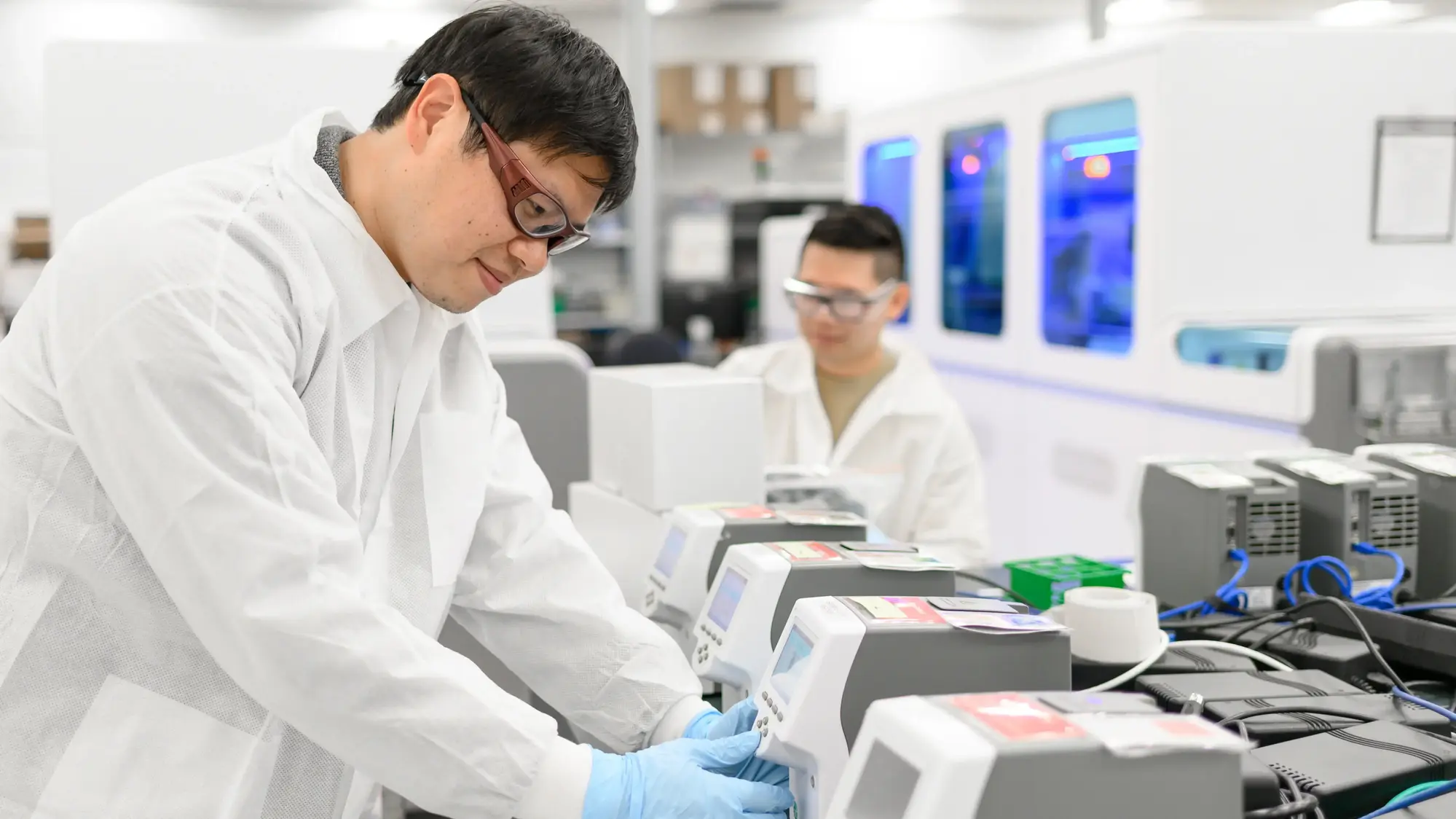
How a leading pharmaceutical company eliminated paper from pCMC workflows
Despite having an established ELN, a leading global pharmaceutical company continued to rely on manual documentation, paper records and fragmented data capture across its pre-formulation laboratories.
By implementing LabOperator, the team transformed how experiments were executed and documented, moving from post-experiment transcription to guided digital workflows at the bench.
The impact
Automated data capture
Device data is captured directly, eliminating manual transcription.
Improved data integrity
Fewer errors and greater traceability across experimental workflows.
Faster workflows
Less time spent documenting, more time focused on research.
Standardised processes
Consistent execution across teams and users.
Seamless integration
Existing laboratory devices and ELN systems connected within a unified digital environment.
What began as a pilot across 10 workflows evolved into a scalable approach to laboratory digitalisation, enabling a more efficient, paperless and future-ready R&D environment.
At a glance
- Customer: A leading global pharmaceutical company
- Lab area: pCMC pre-formulation laboratories
- Starting point: An established ELN, but paper-based execution and documentation at the bench
- Solution: LabOperator, the Lab Execution System (LES) from LabAthena
- Integrations: Laboratory devices and the existing ELN
- Scope: Pilot across 10 workflows, followed by a scalable rollout approach
Questions this case study answers
Why isn't an ELN enough to go paperless?
An ELN records results, but in many labs the experiment itself is still run from paper and transcribed afterwards. LabOperator guides execution at the bench and captures device data as the work happens, then passes structured results on to the ELN.
What are guided digital workflows at the bench?
Scientists follow step-by-step instructions on screen next to the instrument. Device readings are captured automatically and every step is documented as it is performed, instead of being written up after the experiment.
How do you move from a pilot to a lab-wide approach?
Starting with a defined set of workflows builds reusable templates and device integrations that other teams can adopt. The full case study describes how the pilot evolved and what it delivered.
Download the full case study to discover how a leading pharmaceutical company transformed pCMC workflows by eliminating paper-based processes.
Related resources
- What is a Lab Execution System (LES)?
- How to automate lab workflows without robotics
- FAIR lab data: making instrument data machine-readable
- LIMS, ELN or LES: a decision guide for regulated labs
Want to take your own lab paperless? Request a demo.
Get the case study
Complete the form to receive “Automating experimental workflows in pCMC: How LabOperator saved time and eliminated paper” directly in your inbox.