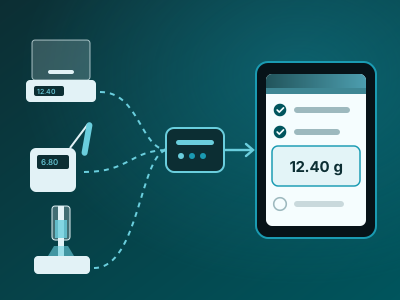
FAIR lab data: how to make instrument data machine-readable
Lab data is FAIR when people and software can find it, access it, understand it and reuse it without having to ask the person who produced it. Whether that happens depends less on the data platform at the end of the chain than on what happens at the bench, where the data is created.
The data has to come straight from the instrument, in an open format, with its context attached at the moment it’s created: sample, method, instrument, user and calibration status. The tools that help are instrument connectivity based on open standards (SiLA 2, OPC UA LADS), standard data formats such as the Allotrope Simple Model, a lab execution system that captures context, and LIMS, ELN or SDMS with open interfaces.
Why lab data so rarely ends up FAIR
The FAIR principles were published in 2016 in Scientific Data. What set them apart was the focus on machines: data should be usable by software, not only by people reading it.
Most lab data falls short of that, for reasons that start at the bench. Instruments write proprietary file formats. Key context, such as which sample, which method version or which balance, sits on paper or in someone’s head. Values are typed by hand into spreadsheets and the LIMS. Each system holds part of the story, and nothing links them.
Cleaning this up afterwards in a data lake is expensive and never complete. It’s far easier to capture the data in a structured, open form with its context when it’s created.
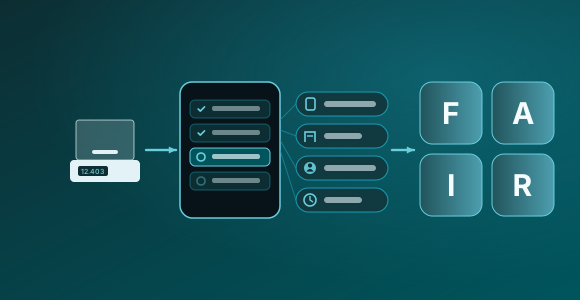
What each FAIR principle means for lab data
The four principles translated into what they need in a lab, what usually gets in the way, and what helps.
| Principle | What it means in the lab | What gets in the way | What helps |
|---|---|---|---|
| Findable | Every result and raw data file has a unique ID and enough metadata to be found by sample, method, instrument or date | Data on local instrument PCs, file names as the only metadata | Capture at the bench with IDs and metadata attached, registered in the LIMS, SDMS or a data catalogue |
| Accessible | Authorised people and systems can retrieve the data through a standard, documented interface | Data locked in vendor software or exported manually | Open APIs, standard protocols, clear access rights |
| Interoperable | Data uses open formats and shared vocabularies, so other systems can read it without custom parsing | Proprietary formats, free text, different names for the same thing | Open device standards (SiLA 2, OPC UA LADS), the Allotrope Simple Model, controlled vocabularies and ontologies |
| Reusable | Data has enough context to be trusted and reused later: method, conditions, instrument status, who did what | Context on paper, missing calibration and method details | An execution system that records each step, the instrument and its status, with an audit trail |
The tools that make lab data FAIR
Open standards for instrument connectivity
SiLA 2 and OPC UA LADS are open standards that give lab devices a common way to describe their functions and deliver data in a predictable structure, so each new instrument doesn’t need its own custom parser.
How the two standards work, and how LabOperator uses them, is covered in How OPC UA LADS, SiLA and LabOperator power the AI-enabled lab.
Standard formats for instrument data
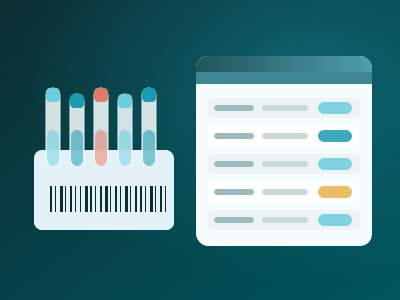
The Allotrope Simple Model (ASM) from the Allotrope Foundation describes instrument data in JSON, using shared terms from the Allotrope ontologies. Converters are available for many common instrument outputs.
Why it matters: results from different vendors’ instruments end up in the same shape, which is what analytics and AI need.
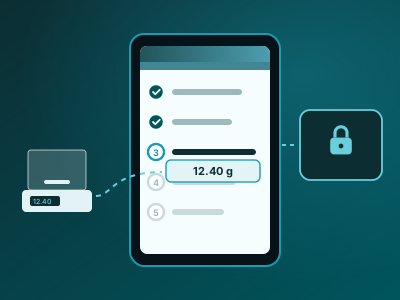
Context captured at the bench
A lab execution system (LES) records each step of the procedure as it happens: which sample, which method version, which instrument and its calibration status, who did it and when. That context travels with the result.
Why that context matters for compliance, automation and AI is the subject of Why metadata is the missing link in the AI-enabled laboratory.
A practical path to FAIR lab data
You don’t need a big data programme to make progress. Start where the data is created:
- Map where data is born: list your instruments, the formats they produce and every point where values are typed in by hand.
- Stop transcription first: connect the highest-volume instruments so values are captured digitally.
- Capture context at the bench: run the procedure in an execution system so sample, method, instrument and user are recorded with each result.
- Use open formats and shared terms: prefer instruments and software that support SiLA 2, OPC UA LADS or ASM, and agree on names for key parameters.
- Register data in your systems of record (LIMS, SDMS or a data catalogue) with unique IDs, and make it available through documented APIs.
- Set governance: who can access what, how long data is kept, and who owns each vocabulary.
In regulated labs the same steps also support data integrity. FAIR is about reuse, while ALCOA+ is about a trustworthy record. Capturing data at the bench with its context covers both, as we show in How ALCOA+ supports bench data integrity in pharma QC.
How LabOperator helps
LabOperator is our vendor-independent lab execution and connectivity platform. It reads data straight from balances, pH meters, titrators and other instruments, and records it in the step of the SOP where it was produced, together with the sample, method, instrument status, user and time.
LabOperator has connected more than 1,000 laboratory devices in research, R&D and pharma labs, and its device portfolio covers over 95 equipment manufacturers. It supports SiLA 2 and OPC UA LADS, and passes structured, contextualised data on to your LIMS, ELN or data platform through its open API.
Related guides and articles
Common questions
What does FAIR mean for lab data?
FAIR stands for findable, accessible, interoperable and reusable. For lab data it means every result can be found by its metadata, retrieved through a standard interface, read by other systems without custom parsing, and reused later because its context is recorded.
Which tools make lab data FAIR and machine-readable?
The main ones are instrument connectivity based on open standards (SiLA 2, OPC UA LADS), standard data formats such as the Allotrope Simple Model, a lab execution system that captures context at the bench, and systems of record (LIMS, ELN, SDMS) with open APIs.
Is FAIR the same as ALCOA+?
No. ALCOA+ is about data integrity: a record that is attributable, legible, contemporaneous, original, accurate and complete, as regulators expect. FAIR is about reuse by people and machines. They overlap a lot, and capturing data at the bench with its context supports both. See How ALCOA+ supports bench data integrity in pharma QC.
Do we need a data lake to make lab data FAIR?
Not to start. A data lake can store and expose data, but it can’t add context that was never captured. Capturing structured data with metadata at the bench is the bigger lever. A central platform becomes useful once that is in place.
Which standards matter for FAIR lab data?
For connecting instruments, SiLA 2 and OPC UA LADS. For instrument data formats, the Allotrope Simple Model. We explain SiLA 2 and OPC UA LADS in How OPC UA LADS, SiLA and LabOperator power the AI-enabled lab.
What is the Allotrope Simple Model (ASM)?
ASM is a JSON-based format from the Allotrope Foundation for instrument data. It uses shared terms from the Allotrope ontologies so that results from different vendors’ instruments can be read in the same way.
Does FAIR matter in GMP labs?
Yes. GMP labs produce large amounts of method, stability and process data that is valuable for trending, investigations and process improvement. Making it FAIR lets that data be reused, while the same capture practices support data integrity requirements.