


How a global biopharma connected a 150-million-compound operation with Xavo
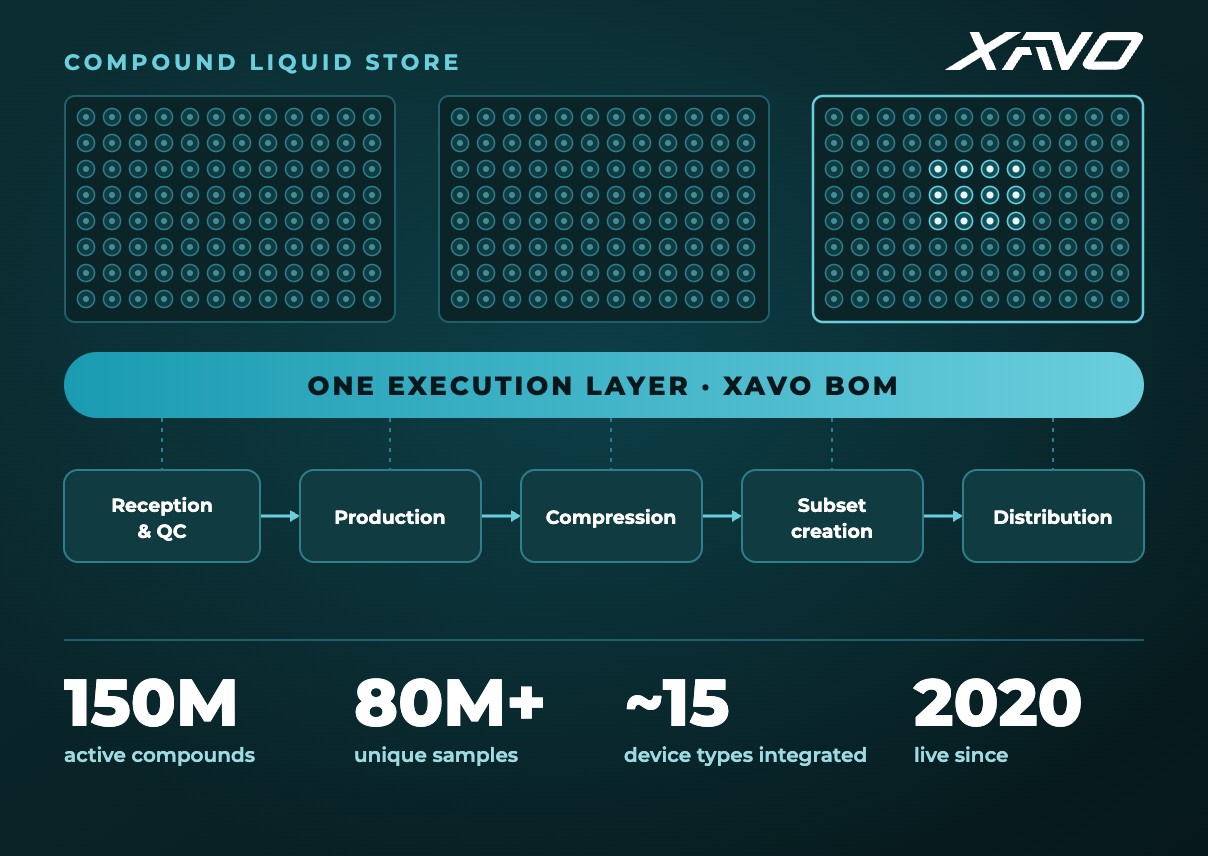
At one of its global R&D sites, a leading global biopharmaceutical company runs a large compound liquid store: 150 million active compounds and more than 80 million unique samples. When the company retired its automated store in 2017, the samples moved to freezers in a cold room. Inventory and workflow management went back to manual processes, spreadsheets and separate tools.
Together with Xavo, the company built the Back Office Manager (BOM). BOM links five processes: reception and QC, production, compression, subset creation and distribution. It decides the next step for each sample based on the state of the material. BOM went live in 2020 and has run 53,187 workflow executions between March 2020 and August 2026. The team adds new functions every year.
The full case study describes how BOM keeps samples, inventory, equipment and process decisions in step as work moves through the lab.
At a glance
- Customer: A leading global biopharmaceutical company, R&D compound management back office
- Scale: 150M active compounds and 80M+ unique samples in the liquid store
- Challenge: Keeping samples, inventory, equipment and process decisions in step after the automated store was retired in 2017
- Solution: Xavo Back Office Manager (BOM), the system of record and execution for five linked processes
- Integration: About 15 device types, 4 automation systems and 5 enterprise systems
- Timeline: Live since 2020, further development and a proof of concept in 2025, still being extended in 2026
Questions this case study answers
What was missing in the lab?
The instruments were already automated. The lab had no system that decides what happens next, moves material, updates the inventory and recovers when a run fails. BOM does this.
How do you run instruments with different integration depths?
Each device is connected as deeply as it allows. Some report live progress and can pause and resume. Others only exchange files. The connection depth sets the recovery options an operator sees, so operators only get options the device can carry out.
How does the system handle changing requirements?
Process logic, inventory and device integration are kept separate. Planners change products, priorities, QC settings, plate and subset definitions and other settings through configuration. No code changes are needed.
What the case study covers
The starting point: a high-volume compound store with a target of five business days from sample arrival to a usable product, and why automated instruments alone did not meet it.
The details: the five linked processes, the rules that decide what a rack needs next, how recovery depends on device capability, how lineage is tracked across container generations, and which decisions stay with scientists.
The outlook: why AI in the lab needs a live view of samples, inventory, equipment, priorities and exceptions.
Related resources
- What is lab sample management and logistics?
- How to automate lab workflows without robotics
- Xavo use cases
- Xavo solutions
Running a compound store or sample operation at scale? Request a demo.
Get the case study
Complete the form to download “Building the connected laboratory: automating R&D at scale”.