What is lab sample management and logistics?
Sample management and logistics software keeps track of the physical material a lab works with: samples, compounds, reagents and the containers that hold them. It also manages how that material moves, from storage to the bench, from one plate to another, and from one site to the next.
In the lab informatics landscape, it answers a question that LIMS, ELN and lab execution systems all depend on but are rarely designed to answer: what material do we have, where is it, and how do we get the right amount, in the right format, to the right place?
Why material is the blind spot in many labs
Many labs have digitized results and documentation but still run sample operations on spreadsheets, freezer logs and the knowledge of a few experienced people. The same problems keep coming back.
Inventory drift
Recorded volumes, concentrations and locations diverge from what is actually in the freezer or store.
Unstructured requests
Orders for samples or plates arrive by email or ticket and have to be interpreted by hand.
Fulfillment by expertise
Choosing sources and calculating transfers, dilutions and plate layouts depend on a few experts or on rigid templates.
Fragile plans
When a source runs short, an instrument goes down or priorities shift, plans are rebuilt manually.
Distributed material
With several sites, CROs and storage partners, it is hard to know who holds what. Shipments are tracked apart from the containers they carry.
Manual hand-offs to automation
Worklists and labels are written or edited by hand, which adds delay and transcription errors.
Treat material as managed data
A sample management and logistics system treats material as structured, continuously updated data, and connects inventory, requests and fulfillment.
One record per container
Identity, contents, amount, concentration, location, state and history, kept current as work happens.
Structured requests
What is needed, in which amount, concentration and format, by when and for where, captured as data instead of free text.
Rule-based fulfillment
Sources, transfers and layouts are derived from current stock, equipment capabilities and the lab's own rules, then turned into instructions for operators and automation.
Unbroken traceability
Every transfer and shipment is recorded, from storage through each intermediate step to the final deliverable.
Core capabilities of sample management and logistics software
Most sample management and logistics platforms combine the following capabilities.
Inventory and storage
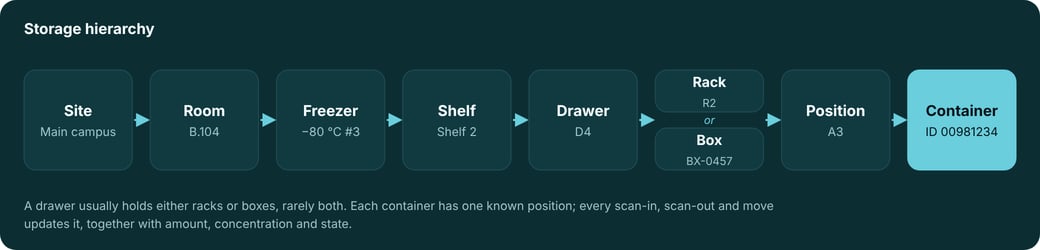
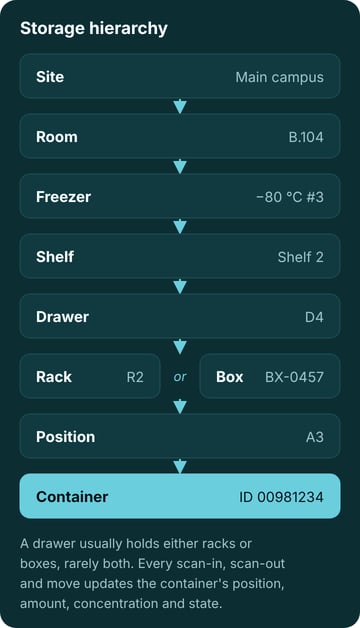
Container-level tracking across storage hierarchies, from site and freezer down to shelf, drawer, rack or box, and position, with barcode or RFID scanning.
Sample state and lineage
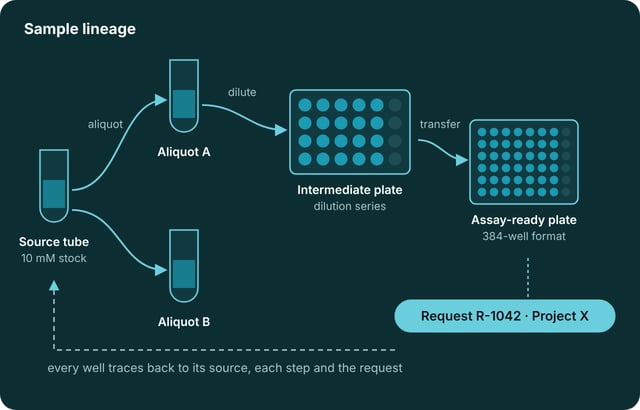
Parent and child relationships across aliquots, dilutions, pools and plates, so every derived container traces back to its origin.
Request management
Structured capture of material, amount, concentration, format, deadline and destination.
Fulfillment planning
Source selection, transfer and dilution calculations, intermediate containers and plate layouts.
Labels and worklists
Labels, picking lists and device-specific instructions for liquid handlers, dispensers and automated stores.
Logistics and shipment tracking
Shipments linked to the containers they carry and tracked from dispatch to receipt across sites and partners.
Re-planning
Plans adjust when stock, equipment availability or priorities change.
Integration
APIs and connectors to LIMS, ELN, sample or compound registration, automation software and instruments.
Sample management vs LIMS vs ELN vs LES
These systems are often used together, but each answers a different question. Knowing which question you need answered helps you choose the right system for the right problem.
Primary focus: tests and results
A Laboratory Information Management System manages samples as records, assigns tests and stores analytical results.
- Sample registration and test assignment
- Result management and specifications
- Reporting and certificates
Primary focus: experiment documentation
An Electronic Lab Notebook is where scientists record intent, observations and conclusions.
- Experiment notes and protocols
- Collaboration and sharing
- Research data and IP protection
Primary focus: execution at the bench
A Lab Execution System guides people through procedures and captures instrument data as the work happens. What is an LES?
- Guided workflows and digital SOPs
- Instrument connectivity
- Audit trail and review by exception
Primary focus: the material itself
Sample management and logistics software tracks what exists, where it is and how much is left, and turns requests into deliverables.
- Inventory, storage and lineage
- Requests and fulfillment planning
- Worklists, labels and shipments
| Criterion | LIMS | ELN | LES | Sample management & logistics |
|---|---|---|---|---|
| Core question | What was tested, and does it pass? | What did we do and learn? | How is this procedure carried out, step by step? | What material do we have, and how do we fulfill this request? |
| Main users | Lab managers, QC and QA | Research scientists | Analysts and technicians at the bench | Sample and compound management, automation teams, CRO operations |
| Unit of work | Sample, test and result | Experiment and project | Individual step, action and reading | Container, request and shipment |
| Inventory depth | Often basic | Minimal | Materials checked at the point of use | Container, volume and position level, often across sites |
| Planning | Fixed workflows | None | Configured procedures | Derived per request from stock, equipment and rules |
| Automation interface | Limited | None | Instrument connectivity | Worklists for liquid handlers, dispensers and automated stores |
| Main value | Oversight and reporting | Knowledge capture and collaboration | Right-first-time execution and data integrity | Material availability, throughput and traceable fulfillment |
Note: The boundaries are blurring. Many LIMS include an inventory module, and some ELNs track reagents. A useful test is whether a system only records what happened to material, or can also plan what should happen next.
Where sample operations sit in the lab software stack
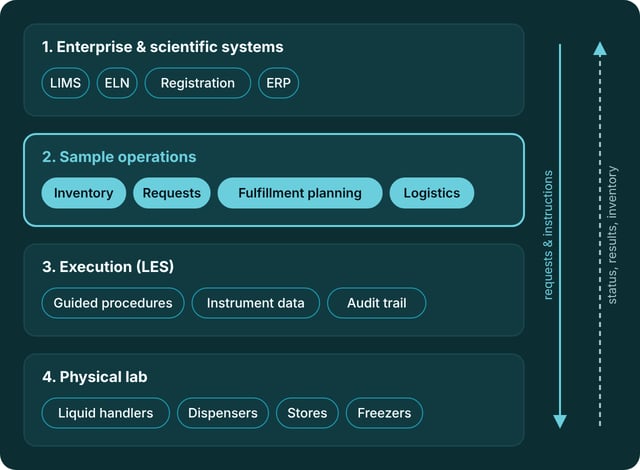
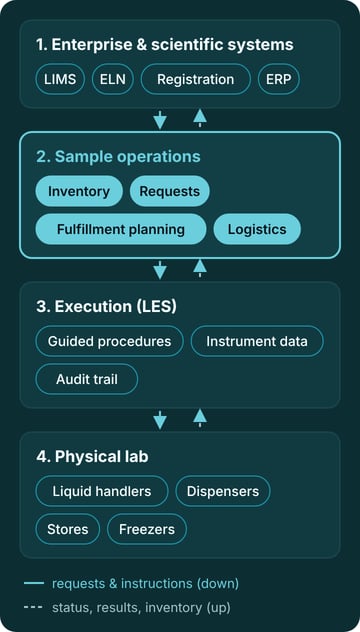
Lab informatics can be pictured as four layers. Enterprise and scientific systems such as LIMS, ELN, registration and ERP sit at the top. The physical lab, with its instruments, liquid handlers, stores and freezers, sits at the bottom. Between them are two operational layers.
The sample operations layer decides what material is used and how it is prepared. The execution layer, often a lab execution system, guides how each procedure is carried out and captures the data. Requests and instructions flow down; status, results and inventory updates flow back up.
Example: from request to assay-ready plate
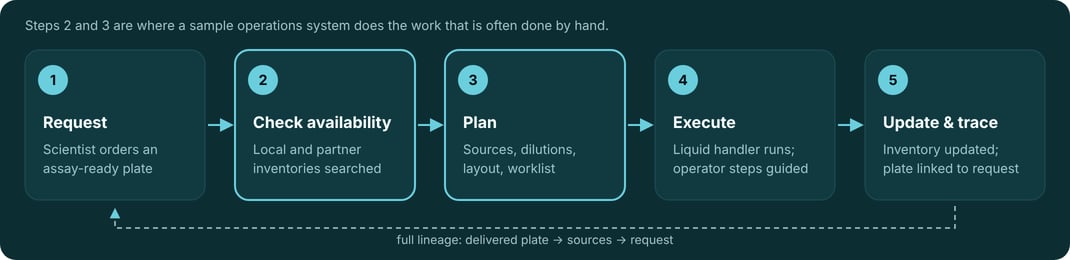
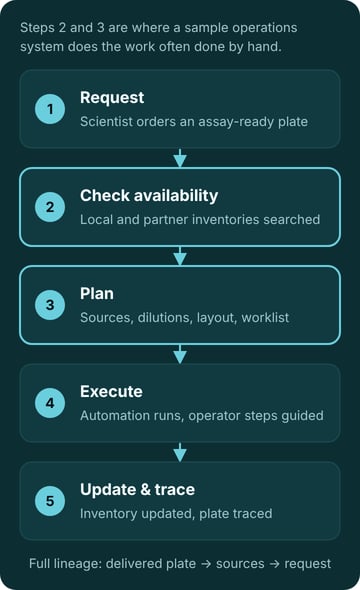
- A scientist requests an assay-ready plate for a set of compounds.
- The sample system checks availability across local and partner inventories and selects source containers.
- It plans dilutions, intermediate plates and the final layout, then generates labels and a liquid-handler worklist.
- The run is executed on automation, with any operator steps guided by an LES. Status flows back.
- Inventory is updated, and the plate is traceable to its sources and the original request. Results go to the LIMS or ELN.
Benefits of sample management and logistics software
The payoff is largest where request volumes are high, material is shared and automation is in use.
Reliable availability
Teams know what exists and where before they commit to an experiment.
Higher throughput
Planning work shifts from people to rules, so the same team handles more requests.
Fewer errors
Barcode-checked transfers and generated worklists replace manual transcription.
Better use of automation
Liquid handlers and stores receive correct, consistent instructions.
Resilience
Plans adapt to shortages, outages and changing priorities instead of being rebuilt by hand.
Network visibility
One view of material across internal sites, CROs and storage partners.
Traceability and data quality
An assay result is only as trustworthy as the material behind it. In many labs, sample lineage is the weak link in data that is otherwise well structured.
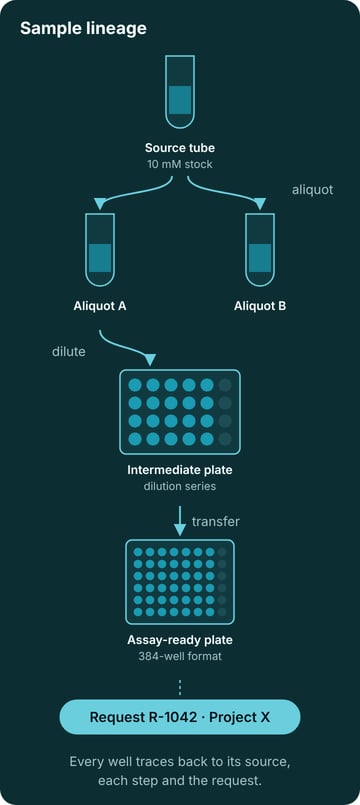
- Lineage: every aliquot, dilution, pool and plate traces back to its source containers and the request that triggered it.
- Attributable, timely records: each transfer, move and shipment is recorded by the user or system that performed it, when it happened.
- Live inventory: volumes, concentrations and locations update as work is done, not reconciled afterwards.
- Context for downstream systems: clean material records make LIMS, ELN and analytics data easier to interpret and reproduce.
How much traceability a lab needs depends on its context. Discovery and research labs mainly need reproducibility and efficiency; regulated environments add formal requirements on top.
Who uses sample management and logistics software?
It delivers the most value where material is shared, requests are frequent and formats are standardized.
Compound management and screening supply
Cherry-picking, replication, pooling and assay-ready plates for screening and discovery teams.
Assay preparation
Dilution series and plate layouts built from scientist requests.
Automated high-throughput labs
Worklists distributed across multiple liquid handlers, dispensers and automated stores.
CROs, CDMOs and compound suppliers
Varied customer orders fulfilled from one inventory and one set of lab capabilities.
Sample repositories
Long-term storage, retrieval and distribution of research material.
Distributed networks
One shared inventory across internal sites and outsourcing partners, with shipments tracked end to end.
How to choose a sample management and logistics system
Use these questions to compare options and to plan implementation.
- Inventory depth: Does it track at container, volume and position level? Across several sites?
- Lineage: Are parent and child relationships kept through every transfer, dilution and pool?
- Requests: Are requests captured as structured data, or as free text attached to a ticket?
- Fulfillment: Does it calculate sources, transfers and layouts, or only record what operators decided?
- Adaptability: Can it re-plan when stock, equipment or priorities change?
- Automation: Does it produce native output for your liquid handlers, dispensers and stores?
- Coexistence: Can it run alongside your LIMS, with a clear rule for which system holds the master record?
- Scalability and cost: Can you start with one workflow and expand without re-implementing?
A pragmatic way to start
- Pick one high-volume, high-friction workflow, such as cherry-picking or assay-ready plates.
- Measure the baseline: setup time, hands-on time and error rate.
- Run it on real inventory data, connected to one automation system.
- Compare and extend to further request types, sites or partners.
Frequently asked questions about sample management and logistics
What is sample management software?
Software that tracks samples and containers, including identity, amount, location, state and history. Many platforms also handle requests and fulfillment.
Is sample management the same as a LIMS?
No. A LIMS centers on tests and results. Sample management centers on the physical material. Many LIMS include basic inventory, but dedicated systems go deeper on storage, lineage, fulfillment and logistics.
Do I need a sample management system if I already have a LIMS?
It depends on volume and complexity. Labs with large inventories, frequent requests, automation or several sites usually outgrow LIMS inventory modules.
How does sample management relate to an LES?
Sample management decides what material is needed and how to prepare it. An LES guides how a procedure is executed and captures the data. The two meet at the bench and at the instrument.
What is sample logistics?
Moving material between locations, such as storage, bench, sites and partners, with each shipment linked to the containers it carries and tracked from dispatch to receipt.
Can sample management work with lab automation?
Yes. Mature systems generate worklists for liquid handlers, dispensers and automated stores, and record what the automation actually did.
How long does implementation take?
It depends on scope and data quality. Starting with one workflow and existing inventory data is usually the fastest route.