What is a Lab Execution System (LES)?
A Lab Execution System (LES) is software that guides scientists and technicians step by step through laboratory procedures at the bench, connects lab instruments, and captures data automatically while the work is being done.
It closes the gap between paper-based bench work and office systems such as a Laboratory Information Management System (LIMS) or an Electronic Lab Notebook (ELN), so results are complete and traceable from the start.
Why modern laboratories need a Lab Execution System
Most labs already run a LIMS to manage samples and results, or an ELN to document experiments. Both are largely office systems. The work itself still happens at the bench, where people follow SOPs, operate instruments and record results, often on paper or in spreadsheets. That gap creates four recurring problems.
Inconsistent execution
Procedures live in paper SOPs or static documents. Each analyst, shift or site interprets them slightly differently, which drives variability and deviations.
Manual transcription
Results are written down and later typed into a LIMS, ELN or spreadsheet. Every copy step adds the risk of transcription errors and lost metadata.
Disconnected instruments
Balances, pH meters, titrators and plate readers often run in isolation. Their data is read off a display or printout instead of being captured digitally.
Compliance and review effort
Gaps in documentation make data integrity harder to prove. Reviewers spend hours checking paper records line by line before results can be released.
How a Lab Execution System solves these challenges
An LES works at the point of execution. It guides people through each step in real time and captures data the moment it is created.
Guided, standardized workflows
Digital SOPs walk users through each step in the right order, with instructions, checks and required inputs. Everyone runs the method the same way.
Automatic data capture
Readings flow directly from connected instruments into the active workflow step. No retyping, fewer errors, and complete metadata such as instrument ID, user and timestamp.
Vendor-agnostic instrument connectivity
Instruments from different manufacturers connect to one digital layer, and each result is linked to the right sample, batch or experiment.
Built-in compliance and traceability
Every action is recorded in an audit trail. Limit checks and enforced steps prevent errors before they happen, and a complete record is ready for review.
Core capabilities of a Lab Execution System
Most LES platforms combine the following capabilities.
Digital SOPs and method authoring
Build step-by-step procedures with instructions, required fields, decision points and version control, without writing code.
Guided execution at the bench
Run procedures on a tablet, PC or instrument-side screen. Steps can be enforced in sequence and cannot be skipped.
Instrument integration
Capture values and files from balances, pH meters, titrators, spectrometers and other devices, using standard interfaces where available (for example SiLA 2 or OPC UA LADS).
In-line calculations and limit checks
Calculate results automatically and flag out-of-specification values as soon as they occur.
Equipment and material verification
Check that instruments are calibrated and qualified, and that reagents and standards are within expiry, before a step can continue.
Audit trail and e-signatures
Record who did what and when. Support electronic signatures and review by exception, so reviewers focus only on deviations.
System integration
Exchange orders, samples and results with LIMS, ELN, ERP, MES and data platforms through APIs.
Structured, reusable data
Store results with full context in a consistent structure, ready for reporting, analytics and AI.
LES vs LIMS vs ELN
LIMS, ELN and LES are often used together, but each plays a different role in the lab software stack. Understanding the difference helps you choose the right system for the right problem.
LIMSPrimary focus: sample management
A Laboratory Information Management System manages samples, tracks their lifecycle and stores analytical results.
- Sample registration and tracking
- Test assignment and result management
- Specifications, reporting and certificates
- Integration with enterprise systems
ELNPrimary focus: experiment documentation
An Electronic Lab Notebook is where scientists document experiments, observations and research data.
- Experiment documentation and notes
- Templates and protocols
- Collaboration and sharing
- Research data organization and IP protection
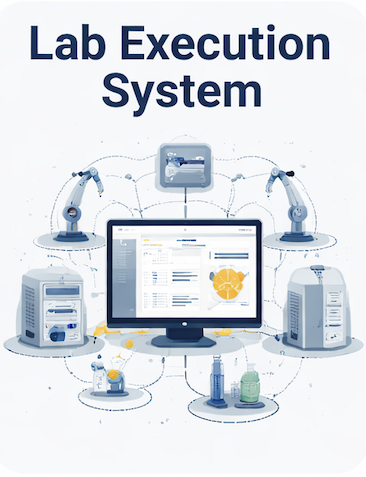
LESPrimary focus: execution at the bench
A Lab Execution System guides people through procedures and captures data from instruments as the work happens.
- Guided workflows and digital SOPs
- Instrument connectivity
- Automatic data capture and in-line checks
- Audit trail and review by exception
| Criterion | LIMS | ELN | LES |
|---|---|---|---|
| Core question | What happens to this sample? | What did we do and learn? | How is this procedure carried out, step by step? |
| Main users | Lab managers, QC and QA | Research scientists | Analysts and technicians at the bench |
| Level of detail | Sample, test and result | Experiment and project | Individual step, action and reading |
| Typical environment | QC, testing and service labs | R&D and discovery | QC, process development and regulated routine testing |
| Instrument data | Usually results imported after the fact | Files attached manually | Captured in real time at the step it belongs to |
| Main value | Oversight and throughput | Knowledge capture and collaboration | Right-first-time execution and data integrity |
Note: The boundaries are blurring. Some LIMS and ELN products include LES-style execution modules, and some LES platforms offer light sample management. When comparing products, focus on the capabilities you need.
Where an LES fits in the lab software stack
Labs run several systems at once: LIMS, ELN, chromatography data systems, ERP and MES, and data platforms. An LES acts as the digital execution layer between the instruments at the bench and those systems.
It receives work orders from upstream systems, guides people through the procedure, captures instrument data at each step, and sends structured, reviewed results back. Data is entered once, at the source, and reused everywhere.
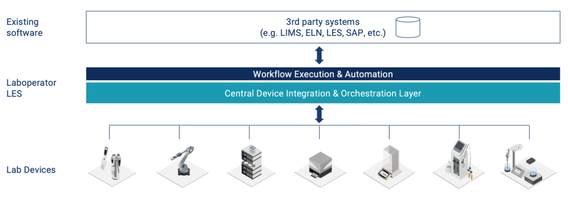
Example: how LIMS, LES and ELN work together
- LIMS registers a sample and assigns the tests it needs.
- LES receives the test order and guides the analyst through the digital SOP, checking that instruments are calibrated and reagents are in date.
- Instruments such as balances or titrators send readings straight into the active step. Calculations and specification checks run immediately.
- LES records every action in the audit trail and routes only deviations for review.
- LIMS receives the approved results for release and reporting. In R&D, the same data can be linked to the ELN experiment.
Benefits of a Lab Execution System
An LES pays off most in labs where processes are still largely manual.
Standardized workflows
Procedures run the same way every time, which reduces variability and deviations.
Fewer errors, less rework
Automatic data capture and in-line checks remove transcription errors and catch out-of-specification results immediately.
Faster review and release
Complete electronic records and review by exception shorten the time from result to release.
Stronger data integrity
A complete, attributable and time-stamped record of every step supports audit readiness in regulated environments.
Better use of existing systems
Integration with LIMS and ELN connects the systems you already own into one data flow.
Data ready for analytics
Structured, contextual data from the bench makes trending, lab performance metrics and AI use cases possible.
LES, data integrity and regulatory compliance
In GxP-regulated labs, such as pharmaceutical quality control, results must be trustworthy and fully traceable. Regulators expect electronic records to follow the ALCOA+ principles: attributable, legible, contemporaneous, original and accurate, plus complete, consistent, enduring and available.
Because an LES captures data at the moment and place it is generated, it supports these principles by design.
- 21 CFR Part 11 (US FDA): audit trails, access control and electronic signatures for electronic records.
- EU GMP Annex 11: requirements for computerised systems, including validation and data integrity.
- ALCOA+: every entry is linked to a user, instrument and timestamp, recorded at the time of the activity.
- Review by exception: reviewers focus on flagged deviations instead of checking every value.
Compliance ultimately depends on how a system is validated and used in your lab.
Who uses a Lab Execution System?
An LES delivers the most value where procedures are repeatable and instrument-heavy.
Quality control labs
Routine release and stability testing in pharma, biotech, food, chemicals and medical devices, where right-first-time results and audit readiness matter most.
Process development and analytical labs
Method development and technology transfer, where standardized execution makes results comparable between labs.
Manufacturing-adjacent labs
In-process control and at-line testing that must connect with MES and batch records.
Contract labs (CROs and CDMOs)
Service labs that need consistent execution for many clients and must provide complete, defensible data packages.
Research labs scaling up
R&D teams moving from exploratory work to repeatable protocols that need structured, reusable data.
How to choose a Lab Execution System
Use these questions to compare LES options and to plan implementation.
- Instrument coverage: Which of your instruments are supported today, and how are new ones added? Is connectivity vendor-agnostic?
- Integration: Are there proven, open APIs for your LIMS, ELN, ERP or MES? Who maintains the interfaces?
- Workflow authoring: Can lab experts build and change digital SOPs without custom code? How is version control handled?
- Compliance and validation: Does the vendor support 21 CFR Part 11 and Annex 11, and provide validation documentation?
- Usability at the bench: Does it work on the devices your analysts use, including with gloves or limited space?
- Deployment and IT: Cloud, on-premises or hybrid? What does the edge setup for instrument connectivity require?
- Scalability: Can you start with one lab or workflow and roll out to other sites without rebuilding?
- Total cost and time to value: What are the licensing, integration and validation costs, and how quickly does the first workflow go live?
A pragmatic way to start
- Pick one high-volume, instrument-heavy workflow with clear pain, such as weighing, pH or titration.
- Measure the baseline: cycle time, transcription errors, review time and deviations.
- Digitize and connect that workflow end to end, including the LIMS or ELN handover.
- Validate, go live and compare against the baseline, then scale to further workflows and sites.
Frequently asked questions about Lab Execution Systems
What does LES stand for?
LES stands for Lab Execution System, sometimes written as Laboratory Execution System. It is software that guides the execution of lab procedures and captures the resulting data.
Is an LES the same as a LIMS?
No. A LIMS manages samples, tests and results at a higher level. An LES manages how each test is actually performed, step by step, at the bench. The two are complementary and are usually integrated.
Do I need an LES if I already have an ELN?
An ELN is designed for flexible documentation of experiments. If your work involves repeatable, instrument-heavy procedures that must run the same way every time, an LES adds enforced execution, instrument connectivity and structured data that an ELN typically does not provide.
How is an LES different from an MES?
A Manufacturing Execution System (MES) controls production processes on the shop floor. An LES plays a similar role in the lab: it controls how lab procedures are executed. In pharma and biotech, the two are often connected, for example for in-process testing.
Which instruments can an LES connect to?
Most LES platforms connect to common bench instruments such as balances, pH meters, titrators, spectrophotometers and plate readers, through serial, network or file-based interfaces. Support for open standards like SiLA 2 and OPC UA LADS makes it easier to add new devices. Coverage varies by vendor, so check it against your own instrument list.
Does an LES help with 21 CFR Part 11 and EU Annex 11?
Yes. Features such as audit trails, access control, electronic signatures and automatic data capture support these requirements. Compliance itself depends on validation and correct use of the system in your lab.
How long does it take to implement an LES?
It depends on scope, integrations and validation effort. Starting with a single workflow and scaling from there is typically much faster than a big-bang rollout across all labs.