


Artificial Intelligence
LES vs ELN: why lab execution needs its own system
Jeroen, Chief Product Officer
Feb 16, 2026
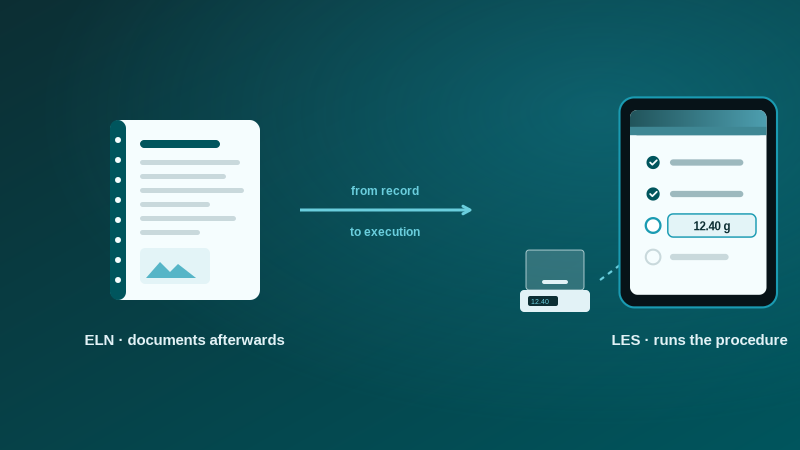
In short: An electronic lab notebook (ELN) records what a scientist did, after the fact. A laboratory execution system (LES) guides the procedure while it runs: it walks the analyst through each step of the SOP, takes readings straight from connected instruments and blocks steps that break the method. In regulated and routine labs, the LES takes over execution from the ELN. In research, the ELN stays as the place to write up and share experiments. Most labs that adopt an LES keep their ELN and LIMS and connect the three.
Comparing all three systems? See our guide LIMS, ELN or LES? Choosing the right system for a regulated lab.
For decades, the Electronic Lab Notebook (ELN) has been the digital standard for laboratory documentation. Scientists document experiments, attach data files, and archive results in searchable databases. The shift from paper notebooks to ELNs was celebrated as a major step forward—and it was.
But as laboratories evolve toward automation, real-time analytics, and AI-driven workflows, a fundamental question is emerging:
Is documentation enough?
The answer is increasingly clear: No.
Modern laboratories need more than a digital record keeper—they need an execution engine. This is why forward-thinking labs are shifting from ELNs to Laboratory Execution Systems (LES).
From Passive Documentation to Active Orchestration
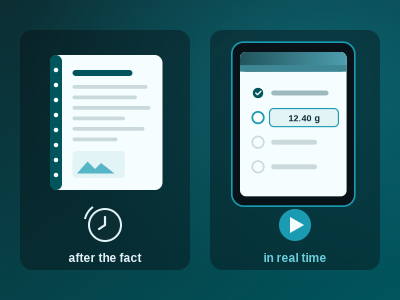 The difference between an ELN and an LES is not incremental—it’s architectural.
An ELN is retrospective. It captures what happened after the fact. A scientist runs an experiment, collects data from instruments, and then documents it in the ELN. The system is a repository—a structured way to store, search, and retrieve experimental records.
An LES is prospective. It guides, enforces, and orchestrates what happens in real-time. The system doesn’t just record the experiment—it executes it. It connects directly to instruments, enforces SOPs, captures metadata automatically, and triggers the next step in the workflow.
This shift mirrors what happened in manufacturing decades ago: the evolution from paper logbooks to Manufacturing Execution Systems (MES). MES didn’t just document production—it controlled it.
Laboratories are now following the same trajectory.
The Five Limitations of ELN-Centric Workflows
As labs push toward higher automation, stricter compliance, and AI readiness, the limitations of ELN-centric workflows become impossible to ignore.
1. Manual Data Transfer Creates Bottlenecks and Errors
In most ELN workflows, data still moves manually.
A scientist weighs a sample on a balance. The balance displays a reading. The scientist writes it down—or exports a CSV file to a USB stick—and later uploads it to the ELN, manually entering the sample ID, the method, and any relevant notes.
This process is slow, error-prone, and strips away critical context. Was the balance calibrated? What was the temperature in the lab? Who performed the measurement? These metadata points are often lost—or entered inconsistently.
2. No Real-Time Process Control
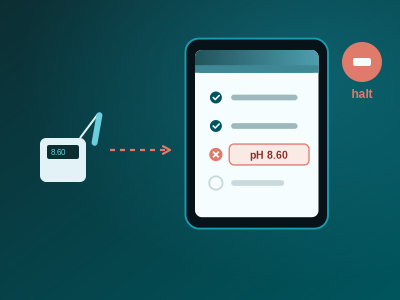 An ELN cannot trigger the next step in a workflow.
If a pH reading is out of range, the ELN cannot alert the operator or halt the process. If a sample needs to move from prep to analysis, the ELN cannot schedule the instrument or notify the next user.
Workflow logic exists in the scientist’s head—not in the system. This works for small, exploratory labs.
It breaks down at scale.
3. Limited Integration with Automation
Robotic systems, liquid handlers, and automated instruments often operate independently of the ELN.
Data reconciliation happens later—if at all. Multi-instrument workflows require human coordination. A scientist manually checks when the preparatory step is complete, then starts the analytical instrument, then uploads results separately.
The promise of lab automation is undermined by software that cannot keep up. Much of the gain doesn’t even need robots, as we show in How to automate lab workflows without robotics.
4. Weak Metadata Capture
Metadata is the connective tissue of the modern laboratory. Without it, data cannot be trusted, reused, or analyzed by AI.
ELNs were designed for human-readable notes—not machine-readable context. Environmental conditions, device states, calibration status, operator identity, and method parameters are often entered manually or omitted entirely.
The result: incomplete records, compliance gaps, and data that cannot power advanced analytics. What it takes to make lab data reusable is covered in FAIR lab data.
5. Difficult to Scale Across Global Operations
When labs rely on ELNs as their primary execution tool, each site develops its own usage patterns. Standardization requires extensive training, governance, and auditing.
Process variability across locations becomes the norm. Comparing results from different sites becomes difficult.
Regulatory audits expose inconsistencies.
For global organizations, this fragmentation is a strategic liability.
What an LES Brings to the Modern Laboratory
A Laboratory Execution System transforms how work gets done. It doesn’t replace the need for documentation—but it redefines where and how that documentation happens.
✓ Direct Device Connectivity
An LES connects directly to instruments—balances, liquid handlers, chromatographs, spectrometers, incubators—using standards like OPC UA LADS, SiLA, or proprietary drivers.
Data flows automatically from the device to the system. No USB sticks. No manual entry. No lost context.
The moment a measurement is taken, it’s captured—along with calibration status, device ID, timestamp, operator, and environmental parameters.
✓ Workflow Orchestration
An LES turns SOPs into executable workflows.
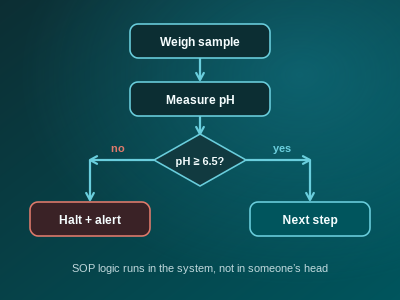
Method parameters are enforced at execution time. The system guides the user step-by-step. Conditional logic enables adaptive protocols: if pH < 6.5, trigger alert and halt; if weight > threshold, proceed to next step.
Multi-device workflows are coordinated automatically. The LES schedules instruments, manages queues, and ensures the right sample reaches the right device at the right time.
✓ Rich Metadata Capture by Design
Metadata is not an afterthought—it’s built into the fabric of the system.
Every action generates a structured record: who, what, when, where, why, and how. User attribution, timestamps, device states, calibration records, environmental logs—all captured automatically.
This metadata makes the data compliant, reproducible, and AI-ready.
✓ Real-Time Compliance and Quality Control
An LES enforces compliance at the point of execution—not during an audit six months later.
Critical process parameters are validated in real-time. Deviations trigger alerts. Non-compliant operations are prevented before they happen.
The system writes the audit trail automatically, providing the technical controls behind ALCOA+, 21 CFR Part 11 and EU Annex 11, without extra manual documentation.
✓ System Integration Architecture
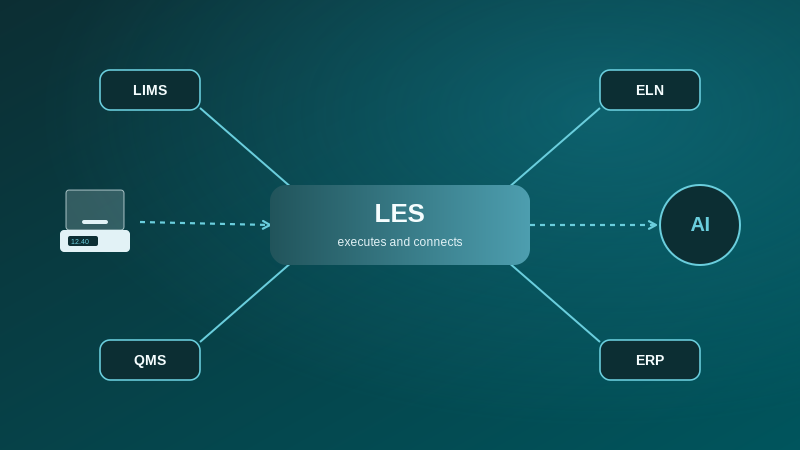
An LES is not an island. It’s designed to integrate.
APIs connect the LES to LIMS, ERP, QMS, and MES systems. Data flows bi-directionally. A sample registered in LIMS triggers a workflow in the LES. Results from the LES update quality records in the QMS.
Cloud-native or hybrid architectures enable distributed teams to work with the same standardized data, from anywhere.
✓ Analytics and AI Enablement
Structured, contextualized data is the foundation of AI.
An LES produces data that machine learning models can consume directly. Predictive maintenance becomes possible. Process optimization algorithms can run continuously. Digital twins can simulate experiments before they’re performed.
The lab becomes a learning system—one that improves itself over time.
When You Still Need an ELN (And When You Don’t)
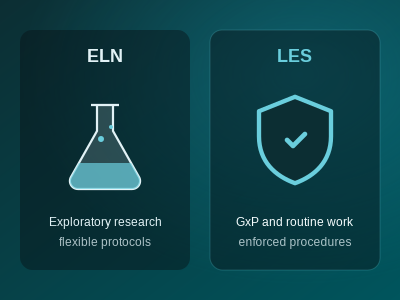 The rise of the LES does not mean the death of the ELN. Understanding when each system makes sense is critical.
ELN Still Makes Sense For:
- Exploratory research with unstructured, evolving workflows
- Academic labs where protocol variability is high and automation is low
- Documentation-heavy environments with minimal device integration needs
- Early-stage R&D where flexibility matters more than standardization
LES Becomes Essential For:
- GxP-regulated environments (pharma, biotech, food, medical devices)
- High-throughput and automated workflows
- Multi-site operations requiring standardization
- AI/ML readiness initiatives
- Process development and scale-up environments
- Labs preparing for digital transformation
“
As a CPO, I see many labs trying to force-fit ELNs into execution roles they were never designed for. The result is workarounds, frustration, and missed opportunities for automation. An LES isn’t just a “better ELN”—it’s a fundamentally different category of software built for orchestration, not just documentation. The labs that understand this distinction are the ones pulling ahead.
The Hybrid Reality
Many labs run both: an ELN for unstructured research notes, and an LES for standardized execution.
Some modern LES platforms include ELN-like documentation capabilities, blurring the lines further.
The trend is clear: consolidation onto fewer, more integrated platforms that prioritize execution over passive documentation.
Real-World Impact: What Changes When You Deploy an LES
The difference shows up in daily work at the bench.
Before LES:
- Scientist exports CSV from balance → uploads to ELN → manually enters sample ID, method, and notes
- Transcription errors creep in and are found late, if at all
- Metadata (calibration status, environmental conditions) is missing or incomplete
- Minutes of manual handling and checking per sample
- Compliance audit finds gaps in traceability
After LES:
- Balance auto-transmits weight + calibration status + timestamp to LES
- Sample ID pre-loaded from LIMS integration
- Workflow validates reading against method parameters automatically
- Complete audit trail generated without human intervention
- No manual entry of instrument values
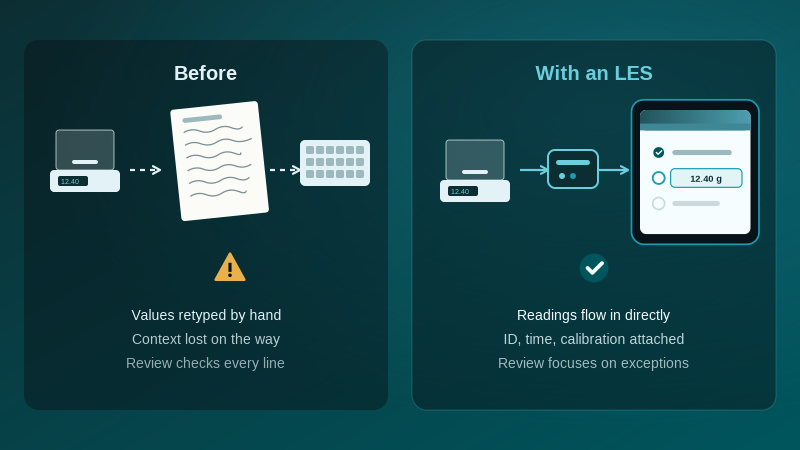
Where labs typically see the difference:
- Less time spent typing and checking instrument values
- Far fewer transcription errors, because values are no longer retyped
- Complete records, with calibration status, instrument ID and operator captured every time
- Shorter review before results can be released
- Less effort preparing for audits
How large the gain is depends on how much is done by hand today. We measure it in a pilot on one workflow before scaling.
The Path Forward: Making the Transition
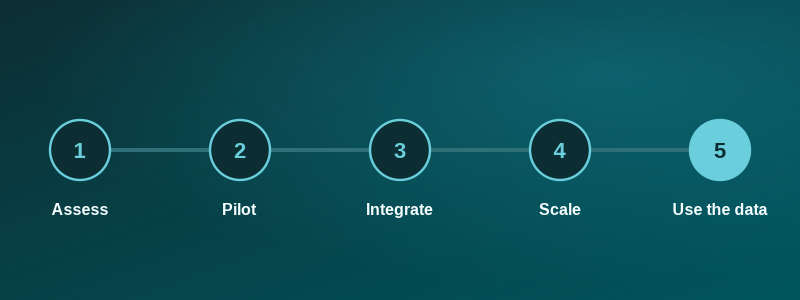
Moving from an ELN-centric model to an LES-driven lab requires planning, but the roadmap is well-established.
1
Step 1: Assess Your Current State
Identify high-value, high-frequency workflows where automation and standardization would have the greatest impact. Map device integration requirements. Evaluate compliance gaps and data quality issues.
2
Step 2: Start with a Pilot
Choose one automated workflow or critical process. Prove value before full-scale deployment. Learn what works, iterate quickly, and build organizational confidence.
3
Step 3: Build Your Integration Layer
Connect critical devices first: balances, liquid handlers, analytical instruments. Establish metadata standards. Ensure connectivity to LIMS, QMS, and other enterprise systems.
4
Step 4: Scale Systematically
Expand to additional workflows and devices. Standardize processes across sites. Train users on an execution-first mindset—where the system guides the work, not just documents it.
5
Step 5: Leverage the Data
Enable real-time analytics dashboards. Launch predictive models for maintenance and optimization. Pursue digital twin capabilities to simulate and improve processes.
Key Success Factors:
- Executive sponsorship and change management
- Cross-functional collaboration (IT, QA, R&D, Operations)
- Vendor selection: prioritize open architecture, non-coding platforms, proven compliance, and strong support
The Future: Where Lab Software Is Headed
The boundaries between LES, LIMS, and MES are blurring.
Unified lab informatics platforms are emerging, like LabOperator—cloud-first, AI-native, and designed for interoperability. These systems don’t just connect devices; they orchestrate entire lab ecosystems.
What this enables:
- Self-optimizing laboratories that learn from every experiment
- Autonomous experiment execution guided by AI
- Real-time supply chain integration that adjusts protocols based on material availability
- Predictive quality release that reduces cycle times
- Fully digital, paperless operations from sample intake to final report
The question isn’t whether your lab will move toward execution-centric systems—it’s when.
The labs making this transition now are building competitive advantages in speed, quality, and innovation that will compound over years.
Questions about LES and ELN
What is the difference between an LES and an ELN?
An ELN is a digital notebook. Scientists use it to document experiments, attach files and share results, usually after the work is done. An LES runs the procedure itself. It shows each step, checks inputs against the method and records instrument data automatically. The ELN looks back at the work; the LES controls it as it happens.
Does an LES replace an ELN?
For standardised, repeatable procedures such as QC testing or routine assays, the LES takes over the part of the ELN’s job that was really execution. For exploratory research, where protocols change from one experiment to the next, an ELN is still the better tool. Many labs run both and connect them.
Can I use ELN templates instead of an LES?
You can, and many labs try. Templates add structure, but they don’t enforce it. An analyst can still skip a step, type a value by hand or use an expired reagent. Template-based workflows also tend to break when the method changes. An LES enforces the order of steps, checks values against limits and takes data directly from the instrument.
Which labs need an LES?
Mainly labs that run the same procedures many times under GxP rules: pharma and biotech QC, contract labs, food and chemical testing, and process development. Signs that you need one are manual transcription from instruments, paper or PDF SOPs at the bench, and long review times before results can be released.
How does an LES connect to instruments?
Through drivers or standard interfaces such as SiLA 2 and OPC UA LADS. In LabOperator, the Connector links balances, pH meters, titrators and other devices, and sends each reading into the active workflow step together with the instrument ID and timestamp.
Does an LES help with 21 CFR Part 11?
Yes, if it provides the technical controls Part 11 asks for: audit trails, electronic signatures, access control and validated operation. How LabOperator covers each requirement is set out on our 21 CFR Part 11 page.
Conclusion
The Electronic Lab Notebook served laboratories well in the era of manual, documentation-first science. But as labs embrace automation, AI, and digital transformation, the limitations of passive documentation become impossible to ignore.
The Laboratory Execution System represents the next evolution: a platform that doesn’t just record what happened, but actively orchestrates it—with precision, compliance, and intelligence.
A number without context is just a number.
An experiment without orchestration is just a procedure.
A lab without execution software is just a room full of disconnected devices.
For laboratories ready to move from documenting science to executing it at scale, the shift from ELN to LES isn’t just an upgrade.
It’s a transformation.